Fulham and Nearby Golf January 2026 We travelled first class on LNER, making brief use of the adequate lounge at Waverley Station—some comfortable chairs, terrible coffee, and pastries in plastic bags—while appreciating the short walk to the platform. Leaving Edinburgh, the line slips through East Lothian, offering glimpses of some of golf’s most storied landscapes: Gullane and Dunbar clearly visible, with Muirfield and the North Berwick links just beyond sight.
Once on board, it was a reminder of how thoroughly Britain’s railways underserve the travelling public. What is marketed as “first class” is scarcely more than an airline’s premium economy, though the carriages were clean and the staff unfailingly friendly. Lunch was the now-standard toasted teacake, and the coffee merely passable. Even so, the journey remains preferable to flying: lower cost, fewer operational irritations, and uninterrupted time to read or work. Passing Berwick-upon-Tweed, Lindisfarne, Newcastle, and Durham, London followed quickly enough.
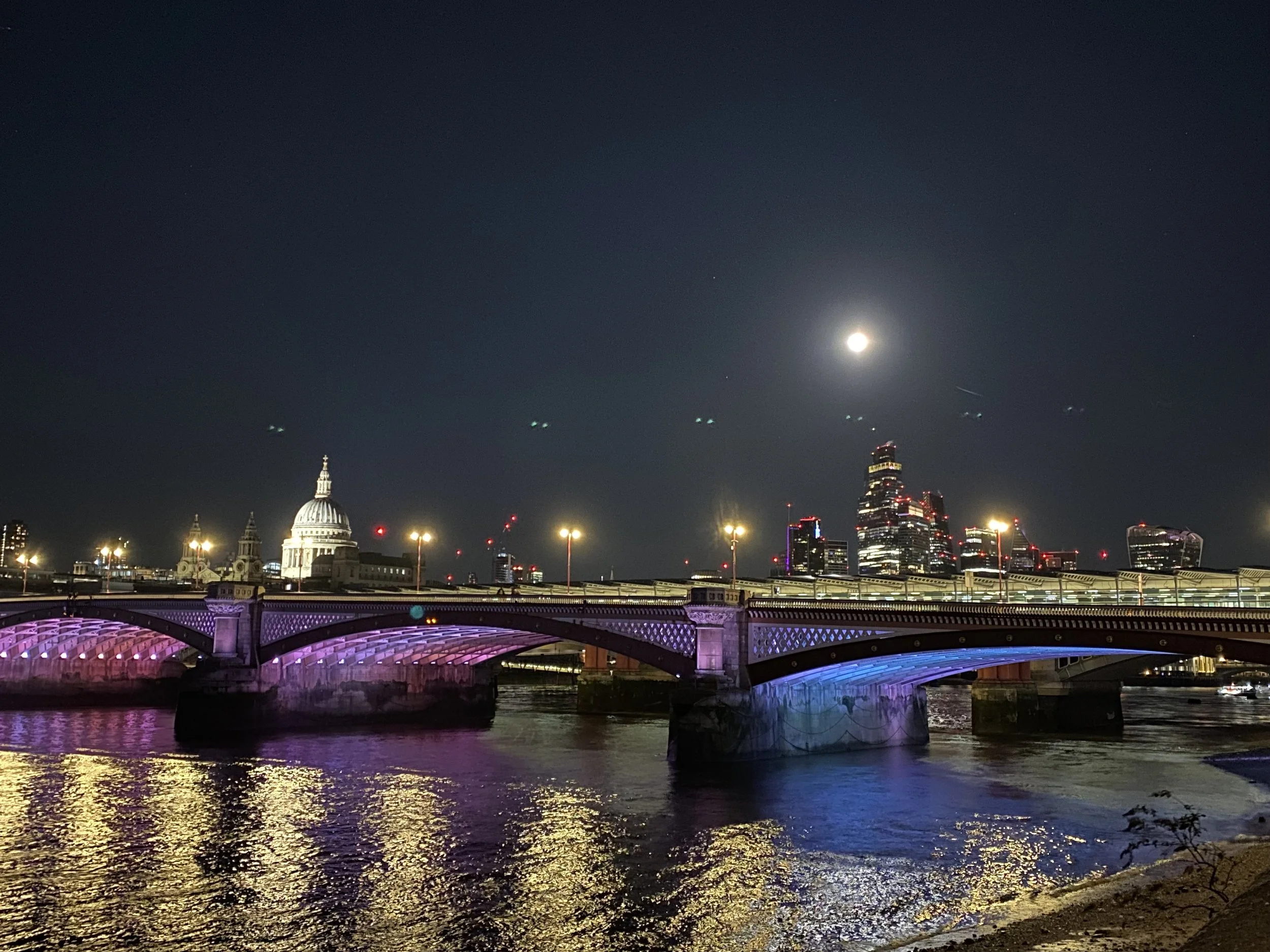
We stayed at the Hyatt Regency London Blackfriars—a genuinely good hotel, well run and thoughtfully designed. The rooms were comfortable, though it is worth requesting a view toward the City. The club dining area is relaxed, the staff consistently excellent, and while it is not inexpensive, the location and transport connections more than justify the cost. The evening improved further at the Oxo Tower Restaurant, where we met old friends. Dinner was very good, the service polished and attentive, and the views across the Thames genuinely impressive. The skyline is anything but static: the Shard asserting itself to the east, the clustered towers of the City marking London’s steady vertical drift, and the Millennium Bridge stitching the banks together with quiet confidence. The river endures. If there was a drawback, it lay in the pricing—a main course with a side comfortably reaching £30—which felt hard to justify even allowing for the setting.
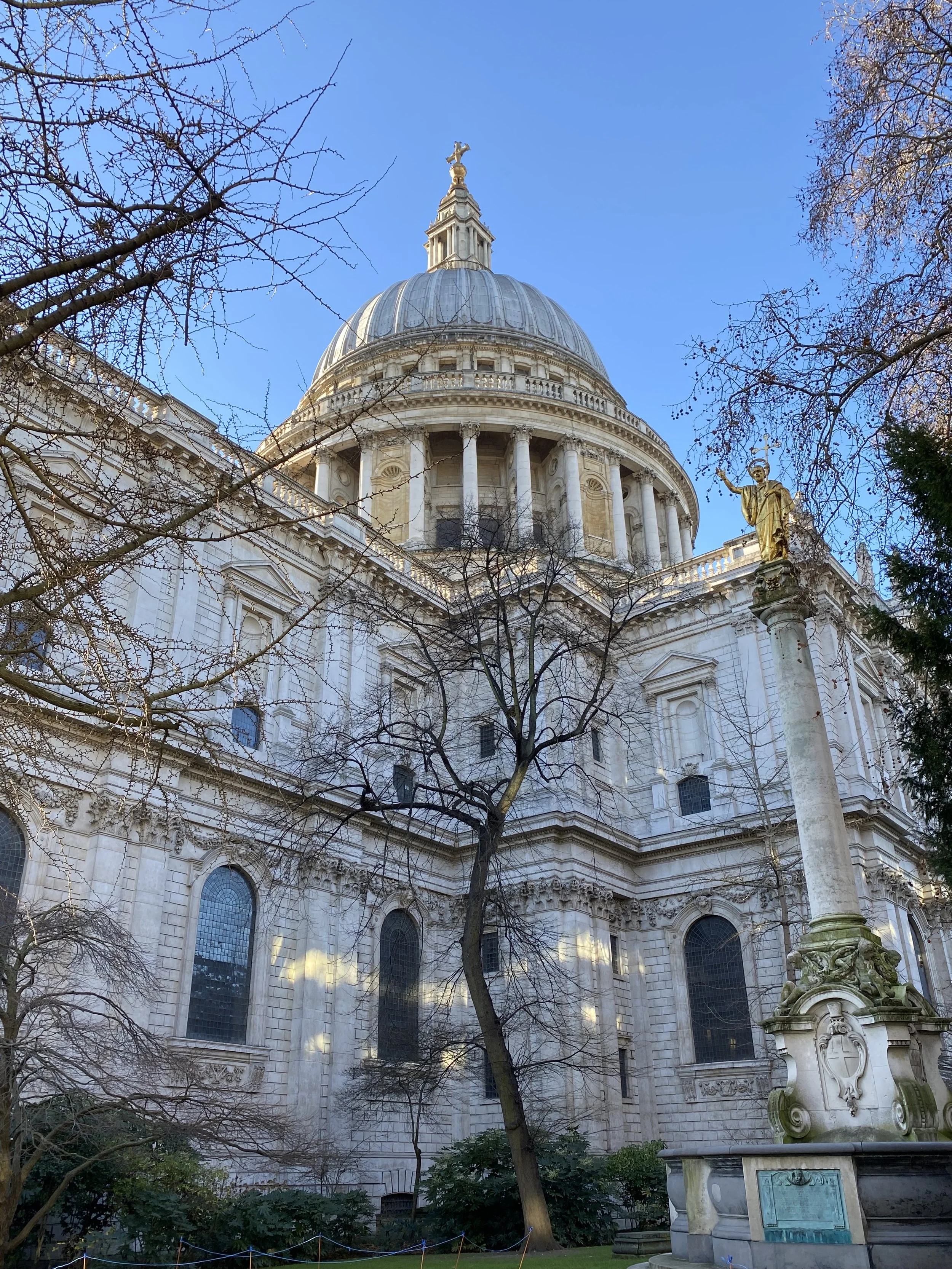
Sunday morning allowed time for a walk around St Paul’s Cathedral before heading west for the football. Few buildings reward unhurried observation so generously. The dome still dominates the skyline, its scale undiminished by surrounding glass and steel, and the sound of the bells pealing across the streets gave the morning a sense of occasion that felt both civic and personal. St Paul’s has stood on this site in various forms since the seventh century, the present cathedral completed in 1710 to the design of Sir Christopher Wren after the Great Fire of London. It has endured bombing, fire, neglect, and reinvention, serving not just as a place of worship but as a stage for national moments—funerals, thanksgivings, and quieter acts of resilience. Its survival, and continued centrality, feel increasingly remarkable. Paternoster Square to the north is a more modern intervention. Its name derives from the medieval Paternoster Row, where craftsmen once made rosary beads. Today it is commercial and open, sometimes criticised for its polish, but standing there with the cathedral rising above it, the continuity of purpose remains easy to sense.
Liverpool, for reasons I have never entirely been able to explain, are my favourite football team. They were playing at Fulham, just six miles away, so I took the District line—twelve stops and roughly thirty minutes from Blackfriars—followed by an easy fifteen-minute walk through the park beside the Thames from Putney Bridge. The route is straightforward but demands a little attention: the correct gate entrances are at the Hammersmith end, numbers 51–55, and missing them sends you needlessly the long way round. Walking to and from the stadium is part of the appeal. Families fill the area, dogs and pushchairs sharing the path with supporters. New apartment blocks line the river, offering impressive views and an easy commute back into the City via Hammersmith or Putney Bridge. Parks, informal bars, and shared social spaces give the neighbourhood a relaxed, almost self-contained feel. On the city side of Craven Cottage, the old stadium presses in tightly—familiar and compressed. On the riverside, the new stand announces itself with confidence: modern, expansive, and quite literally in the Thames. Parts of the surrounding walkway are set with metal grids through which the river is visible below, rowers passing as the tide moves steadily upstream. The Riverside Stand itself is steep and compact, offering excellent sight-lines throughout. It also provides an array of dining and drinking options, ranging from the predictable to the faintly surreal—cheesy chips, and, inexplicably, blueberry muffins handed out by a cheerful attendant.
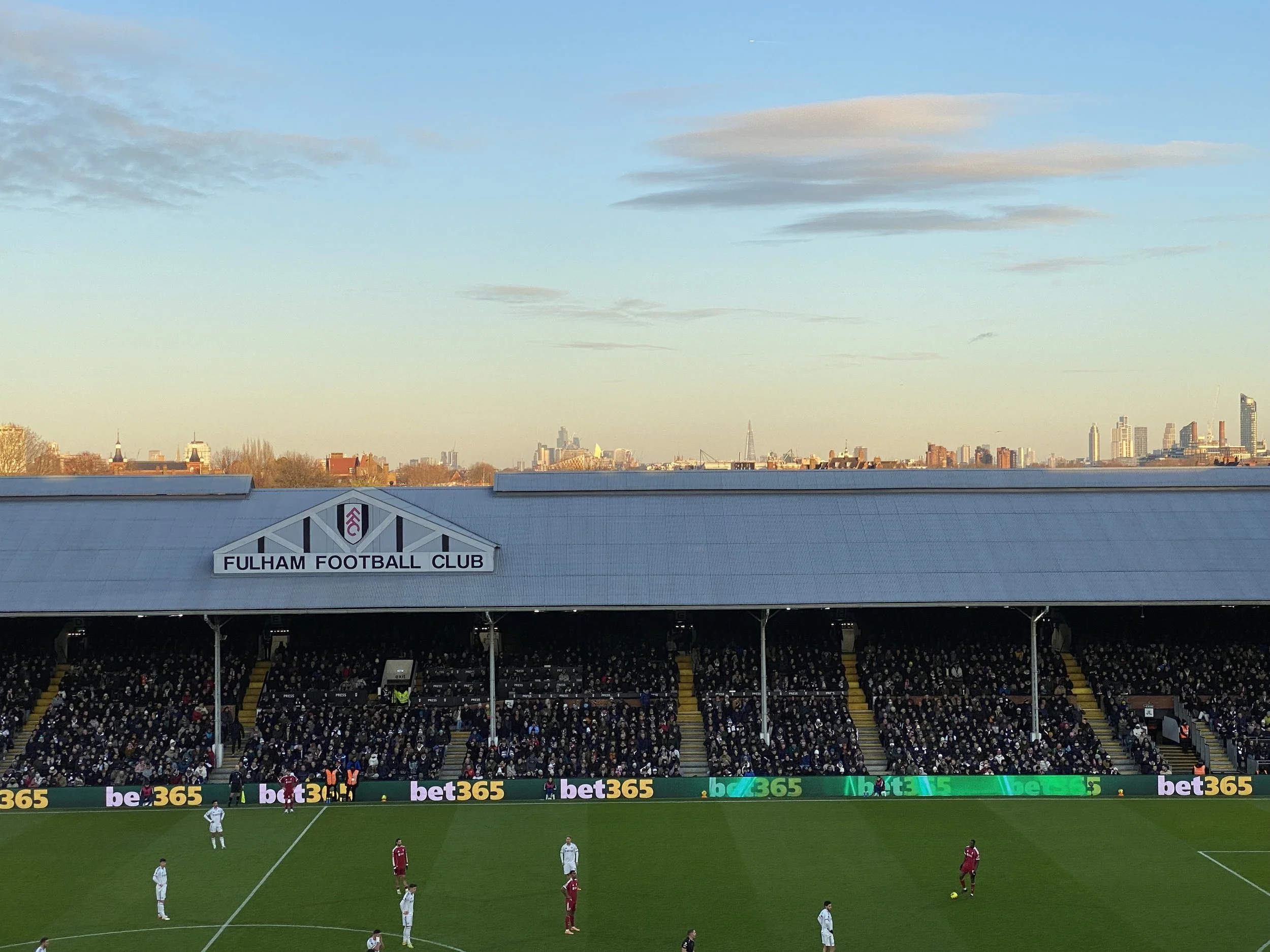
The crowd reflected the setting: noticeably different from Leeds, with more families and more overseas supporters. One Liverpool supporter from Kuwait struck up conversation with cheerful confidence, entirely at ease. The match more than justified the journey. Liverpool dominated the opening fifteen minutes before Fulham scored a goal that appeared offside, though a shoulder was deemed sufficient to play the scorer on. The game then ebbed, Liverpool still looking the more likely, and Wirtz duly scored. In the second half, Liverpool found the net twice more, both ruled out for offside, before Fulham struck back and came close to winning, hitting the crossbar. Liverpool then scored what looked to be the decisive goal in added time, only for Fulham to equalise seconds later with a superb long-range strike. With injuries mounting, seeing Cody Gakpo paired centrally with Wirtz felt improbable, yet both scored, and Liverpool were desperately unlucky not to win. It was a chaotic, absorbing, and thoroughly enjoyable match.
The return was as easy as the arrival: a twenty-five-minute walk back to Hammersmith and the District line east to Blackfriars. Several tempting dinner options presented themselves en route—the River Café, The Blue Boat, and The Reach Brasserie—each requiring restraint. The crowd drifted away calmly, with no hint of trouble. What lingered was not just the game, but the sound of it.
Football crowds sing almost continuously—loud, repetitive, sometimes crude, and deliberately provocative. It is not especially musical, but it is highly organised in its own way: thousands of people aligning emotionally through shared voice. The following evening, at Wigmore Hall, the Christ Church Choir of Oxford produced a similar sense of collective focus and emotional lift, but through entirely different means: trained voices, shared interpretation, and discipline accumulated over years. Nothing was spontaneous; everything was intentional. What struck me was not the contrast, but the connection. Football chants and choral music sit on a continuum of collective expression—different techniques serving the same impulse to belong and to amplify feeling through voice.
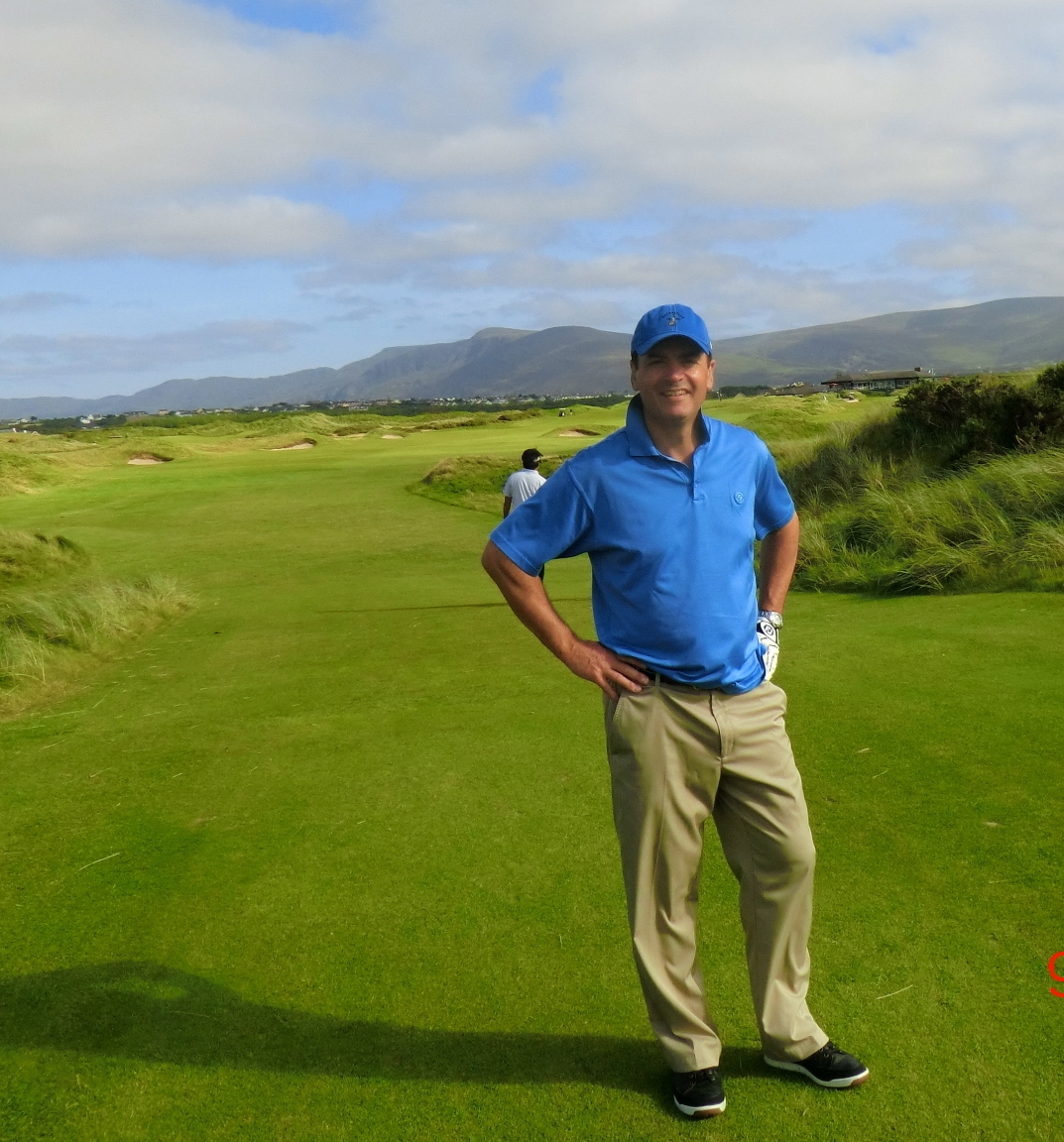
Golf, yes, I remembered to add something- Just west of here, Wimbledon Common Golf Club occupies an elevated and wonderfully exposed stretch of common land. Nearby, Royal Wimbledon, founded in 1865, is among the oldest clubs in England, while Fulwell, laid out by J. F. Abercromby, leans decisively toward classical heathland principles.