Gill and I set off from Gullane on a scenic 180-mile drive through Scotland’s countryside, heading for Oban as the western gateway to the Outer Hebrides, with a return planned via Ullapool. The route took us past Loch Lomond, where the views were predictably magnificent, but the real highlight was the old military road over Rest and Be Thankful—a stretch that fully earns its name. We stopped for lunch in Arochar and spent time in Inveraray, home to Inveraray Castle, which is well worth a visit.
Oban itself felt a little tired, with several fine buildings clearly in need of investment. That said, we found good coffee at Kronks and enjoyed walks up to McCaig’s Folly and out to Dunollie Castle, both of which offer strong perspectives on the town and its history. A short drive to Pulpit Hill provided a different vantage point and was worth the effort.
Dining in Oban was a pleasant surprise. We had two excellent dinners—one at EE-USK and another at The Waterfront Fish House—where the quality of the fish ranked among the best we have had anywhere.
Golf: Glencruitten Golf Club
Just outside Oban lies Glencruitten Golf Club, the home course of Robert MacIntyre. The course dates from the early 1900s and was designed by James Braid. Short by modern standards—around 4,200 yards and a par 62—it is nonetheless demanding. Routed across a steep hillside, it relies on elevation, angles, and intelligent positioning rather than length. Like many Braid designs, it rewards restraint and course management rather than power.
To the Outer Hebrides
Travel through the islands is shaped by the ferry network operated by Caledonian MacBrayne, and in practice the ferries become part of the experience rather than a necessary inconvenience.
We took the ferry from Oban to Castlebay on Barra, a crossing of around four and a half hours. The route passes through the Sound of Mull before heading into open Atlantic waters. We were fortunate with calm seas, which made for a relaxed journey and fine views throughout. The vessels are comfortable, with food service and plenty of space, and the crossing never felt long.
Barra
We stayed at the Barra Island Hotel, run by welcoming and attentive hosts. Breakfast and dinner were consistently good, served in a comfortable dining room and lounge. The building itself is unusual—the architect intended it to resemble an upside-down boat. The rooms are small, water pressure is low, and hot water requires patience, but the view across the bay more than compensates. Gill went swimming; I did not. Temperatures hovered between 50 and 60 degrees, assuming you could find shelter from the wind.
Barra is compact and easy to explore. We arrived towards the end of the season, which suited us well, as the narrow roads with passing places would feel busy in high summer. There are several good walks, and the nearby island of Vatersay—reached by causeway, a recurring feature throughout the Hebrides—is worth visiting.
We had excellent lunches at the Garadh Community Centre. Facilities like this appear across the islands, many supported by National Lottery funding, and they seem a genuinely good use of money. Dining options are limited. Apart from the hotel, we tried the Castlebay Hotel and the Craigard Hotel. Both enjoy fine harbour views, but the food was nothing to write home about. One place we particularly enjoyed was the Barra Gin Distillery, which is also moving into whisky production.
Golf: Barra Golf Club
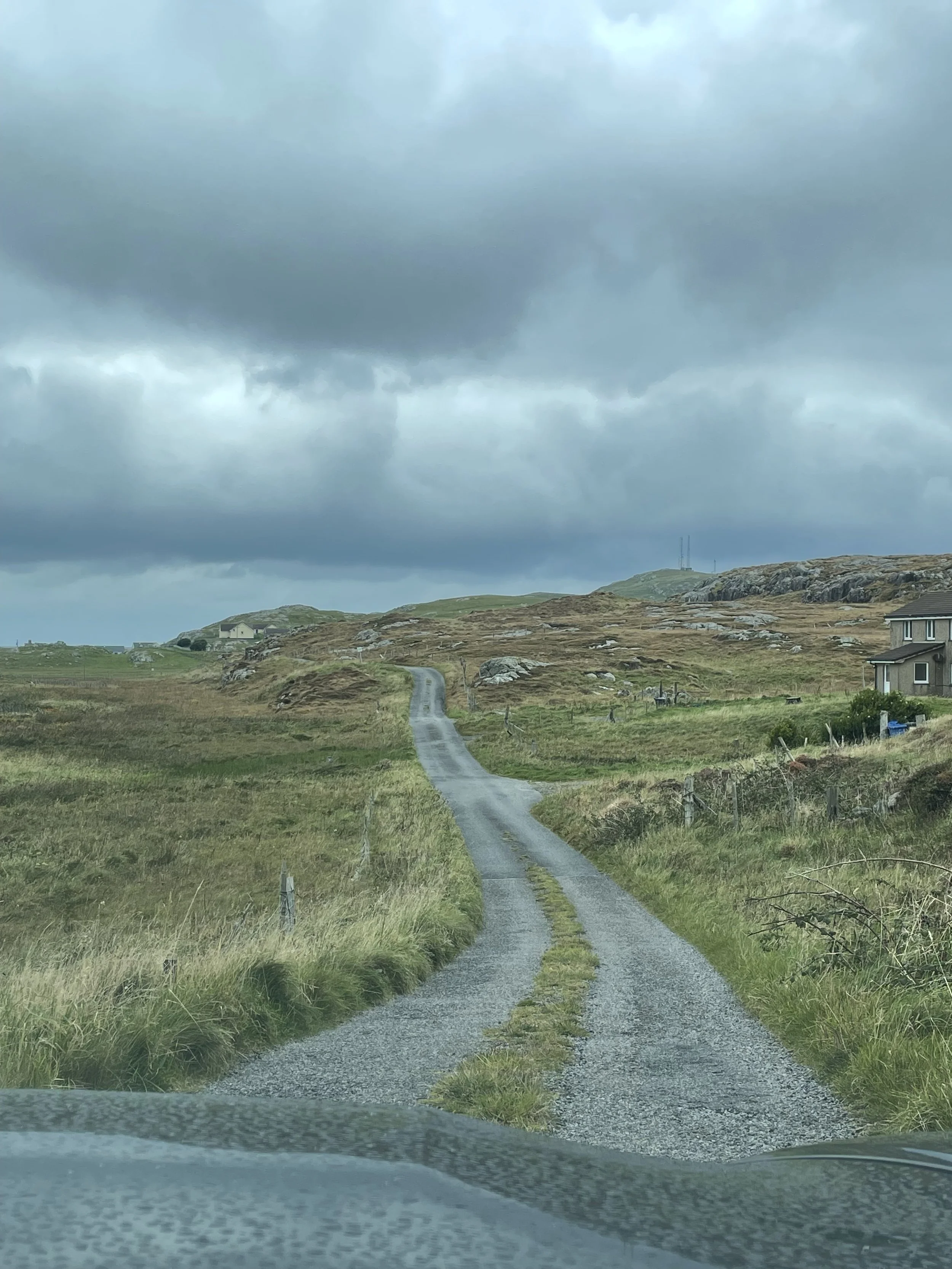
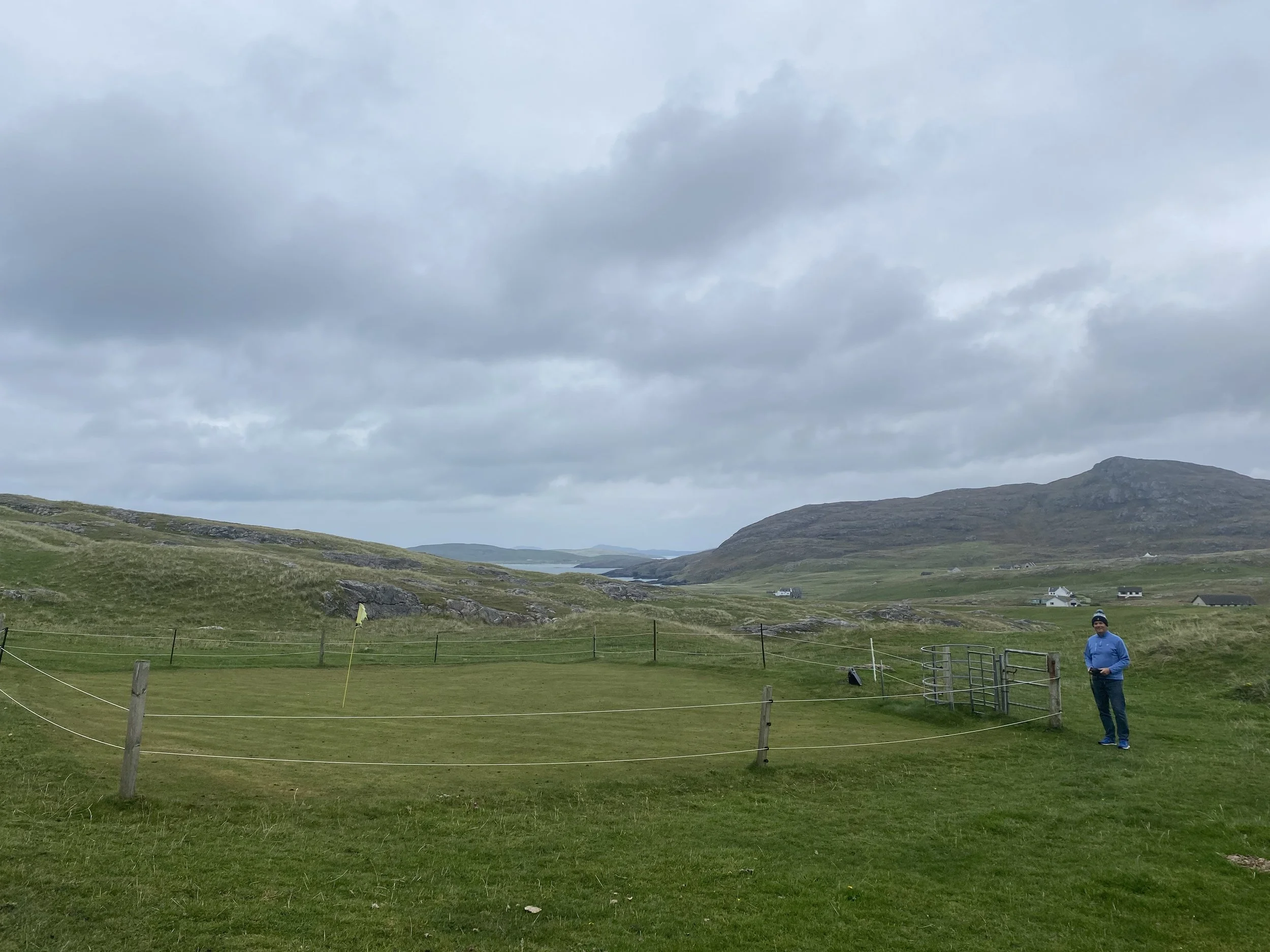
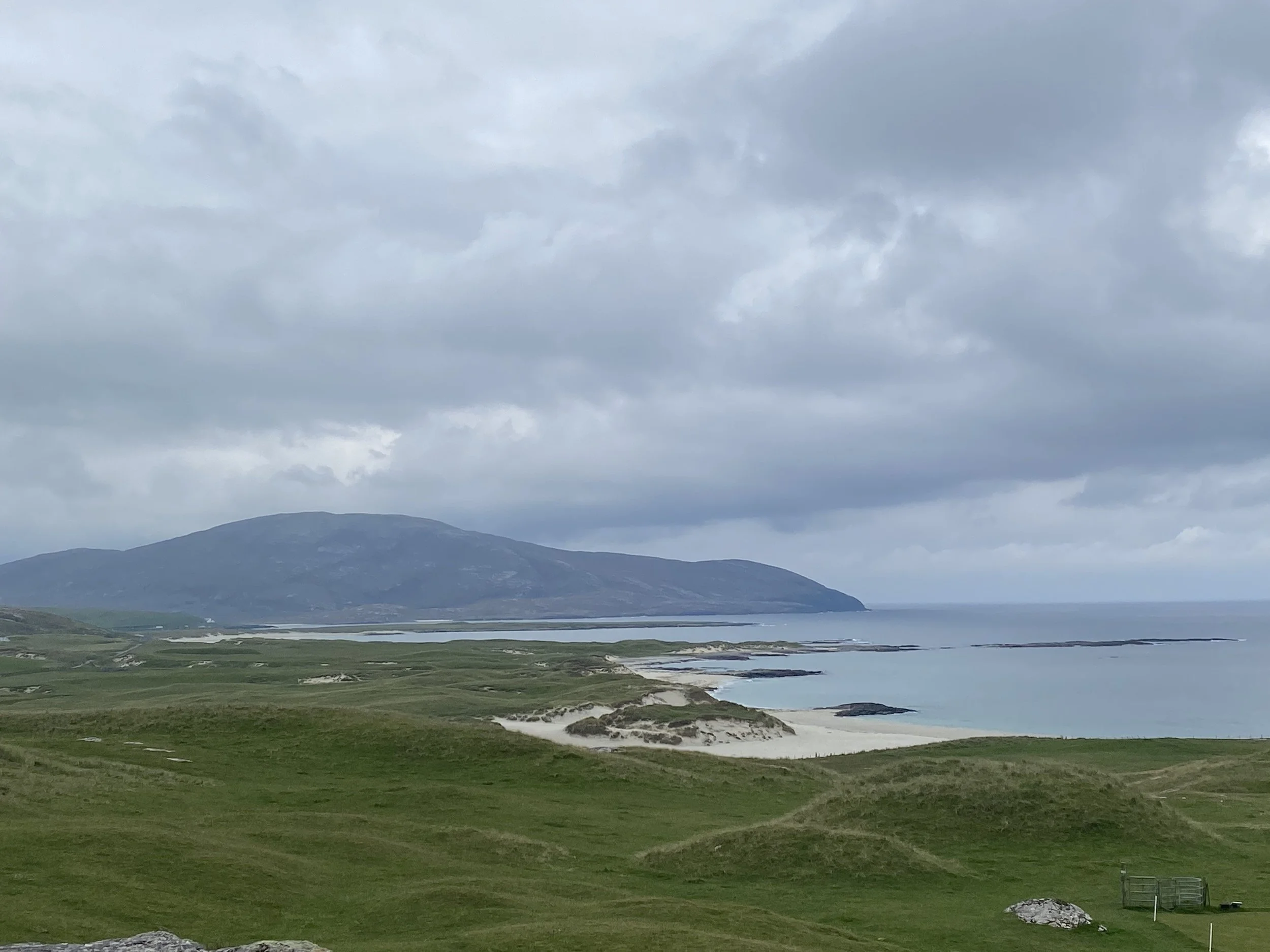
Barra Golf Club, established in 1992, is the most westerly golf course in the UK. Getting there involves a narrow, bumpy single-track road that prepares you for what follows. The course sits on a hillside running down toward the beach, with uninterrupted views over the Atlantic. Beyond that lies Greenland.
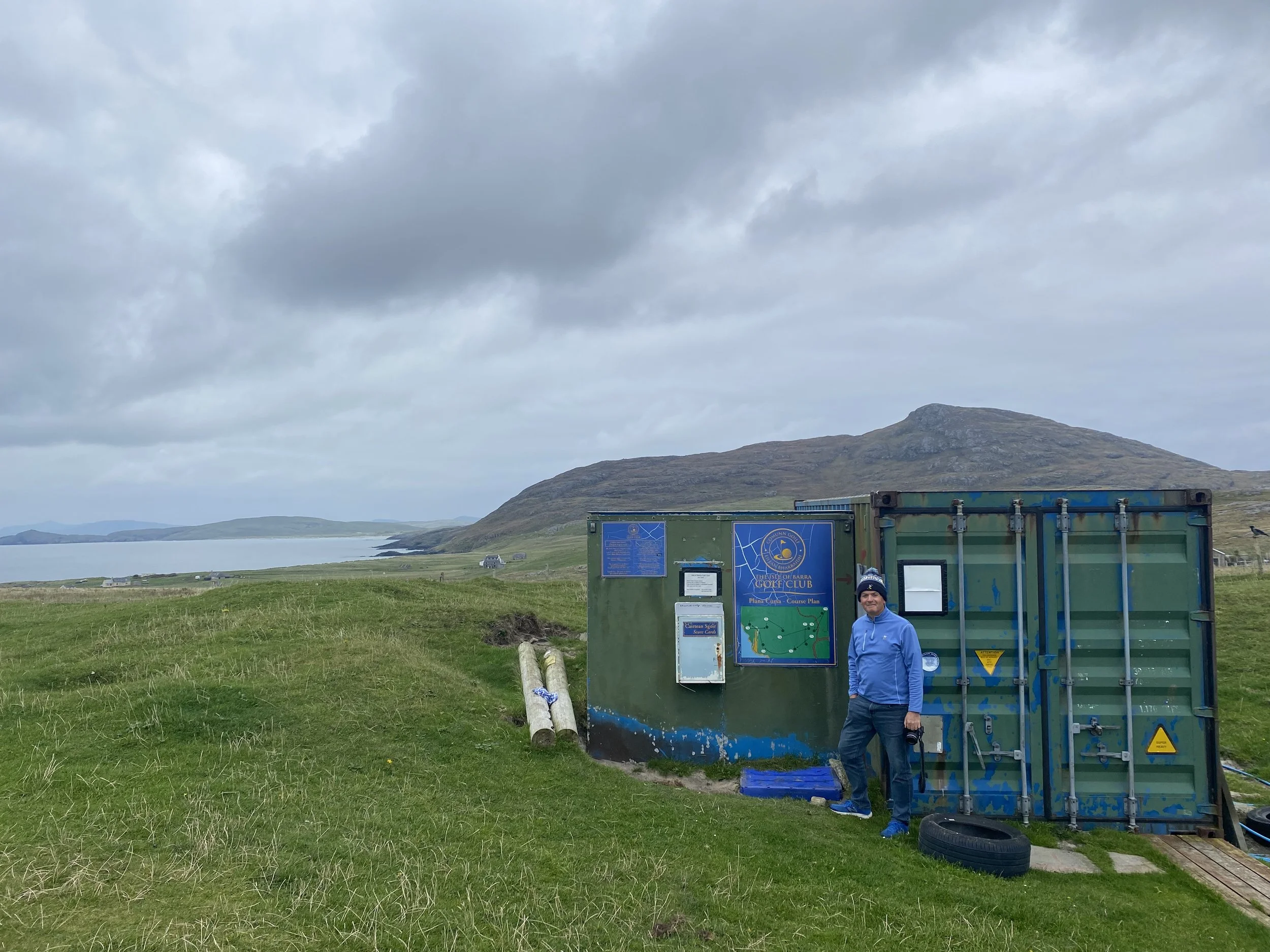
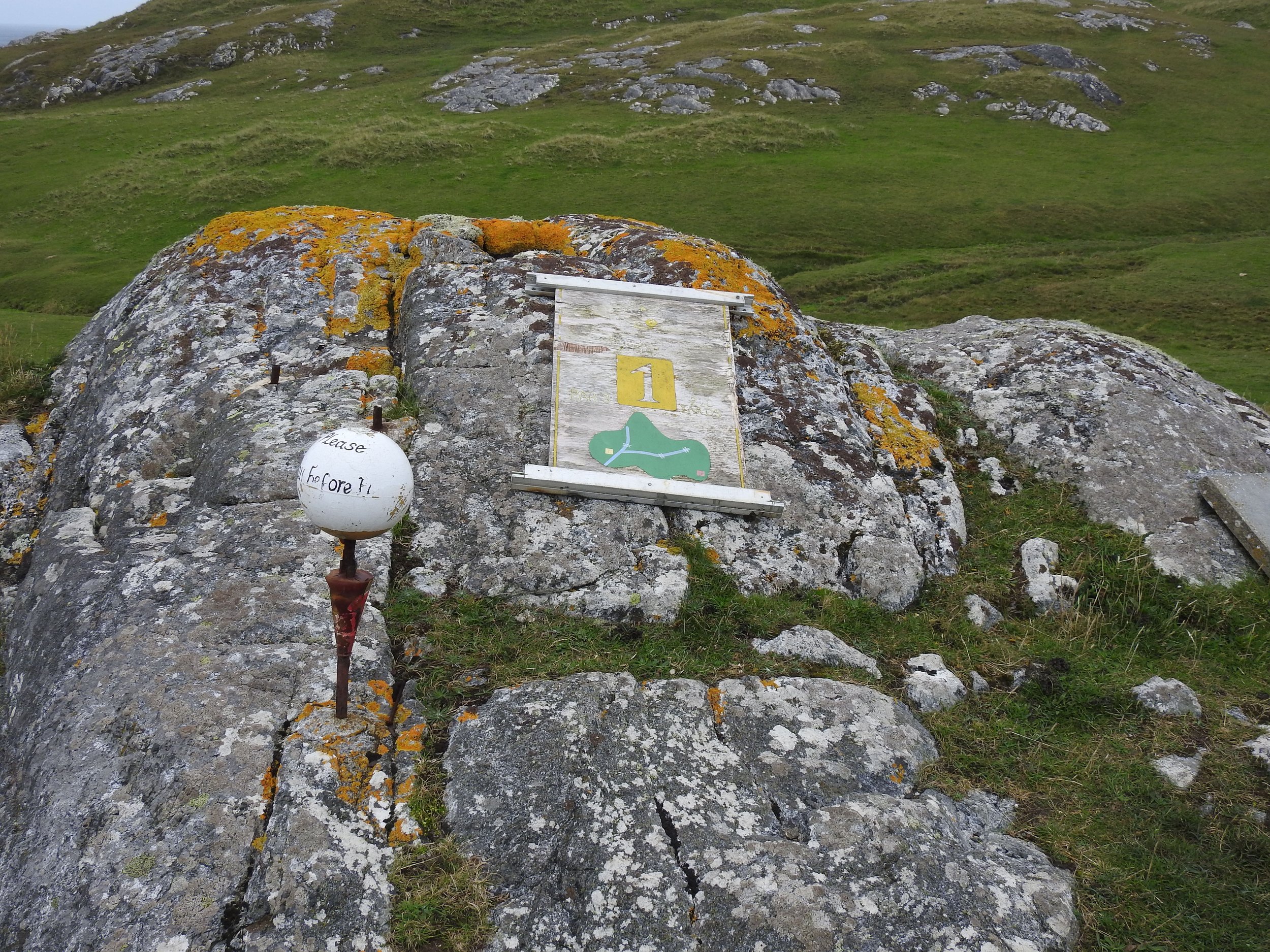
The course is entirely rustic. There is no conventional clubhouse—just an old shipping container that appears to store equipment—and green fees are paid via an honesty box (£10). The first tee is easy enough to find; the first green less so. Calling the playing corridors “fairways” is generous, as the land between tee and green remains largely natural. The greens, however, are the highlight. Each is surrounded by electric fencing and accessed via turnstile gates to keep livestock off.
The course is rated 65.6 with a slope of 113 from the white tees. At roughly 4,920 yards, the nine holes are played twice. The greens would cause apoplexy at Winged Foot—running perhaps at six on the Stimpmeter—but this is Barra, not a USGA championship venue. All that said, it is enormous fun.
This describes the rest of the trip.
South Uist via Eriskay:
From Barra, we took the ferry to South Uist via Eriskay. South Uist is quite different from Barra. It’s much bigger and has some spectacular mountains to the west.
It also has Ashkernish golf course.
Golf:
The course was developed originally in June 1891 by "Old" Tom Morris and Horace Hutchinson. The course experienced a pretty turbulent history - it was reconstituted into a 12 hole course in the 1930’s, and a new layout was put in place in 1970; it was only in the early 2000’s that the original design was restored under the guidance of Martin Ebert, finally re-opening in 2008. Since then both Mike Keiser and architect Tom Doak have been involved to support the club’s continued development. T
Benbecula:
After visiting Ashkernish, we drove up to Benbecula. This is a tiny island south of Harris, linked via causeways. We stayed at the ominously sounding Dark Island hotel (hotel) which was a perfectly acceptable place. It is close to a lovely bay, and about a 15 minute drive to the main town. We had dinner one night in the hotel - ok. The other night we went to Charlie’s Bistro (Charlie's). This was terrific. We had a really great meal, and the service was just super.
Golf:
Benbecula is golf is right at the airport. Apparently some US military guys started the club in the 1960’s. There are signs that the old runways are in the fairways for some holes, and you play right next to the current active runway. Not that its terribly active to be fair.
North Uist:
Our journey continued to North Uist, where we visited various galleries and enjoyed delicious lobster rolls at a café on Berneray (Berneray Shop and Bistro), which served some of the best we've ever had.
South Harris:
Driving from Leverburgh to Harris Golf Course revealed stunning beaches like Seilbost and Luskentyre that rival tropical paradises.
Golf:
The Isle of Harris golf course website is in an absolutely beautiful location. It’s just a little hard to find the clubhouse as it is tucked into the hill at the crest of the road. The Club seems to originate from the 1920’s, but was re-opened in 1986, and the members bought the club in 2000.
Lewis:
From Harris, we drove up to Stornaway. This is a really spectacular drive. The mountain range off to the west is just amazing.
We stayed at The Cabarfeidh (cabarfeidh). This is a good hotel, which is going to get better as it goes through significantly renovation. The rooms are very comfortable and breakfast and dinner quite nice. Again, the staff were just terrific.
The town is quite small - well it has 6,000 people out of the total population of around 30,000 across the Hebrides. There are a couple of nice shops. We really liked Kopi Java, a great place to get coffee and snacks. ( Java). Blake’s Bar and Grill on Bank Street was also really quite good. The town has a rather striking memorial to the soldiers who fell during the first great war. Its on a hill that affords sweeping views of the area and well worth the visit.
We went to the Coll Pottery Centre, about 5 miles out of town. (Pottery). We thought the pottery was really very good.
We also took a trip to The Butt of Lewis lighthouse at Ness Point. ( Butt).
We also drove over to the amazing Callanish Standing stones. These stone circles are really fascinating, and there are several of them in the area. (Stones) . Why and how people built these circles is the subject of much speculation. They seem to date from 2900BC, that makes them older than Stonehenge.
From Callanish we drove over to the Gerarranan Blackhouse Village. Again, this is a fascinating glimpse into the very distant past. There is a good amount of information about the place, and some of the houses have been upgraded and you can stay there.
I guess the one thing we missed out on in Stornaway was Lews Castle. The museum has several Chessmen, but it only opens a few days a week.I think the Castle has been converted to apartments. A shame in many ways as it is an absolutely lovely building with very nice gardens to enjoy.
One final note for future review: Lord Leverhulme bought the Island of Lewis in 1918 and a year later both Islands of Harris. His vision to transform the island economies failed and he reneged on land deals for crofters made at the time of the war. He wanted to industrialise and force a shift away from crofting. That did not play well and his legacy is rather tainted by this plus the failure of his various schemes. You can find out more about this fascinating history.
Golf:
Our final golf visit. The delightful parkland course at Stornaway(website) just a few minutes from the center of town and right next to Lews Castle. The course was developed in 1947, although subsequent years saw major alterations. We did not play, but the course looked fun, laid out on the side of a hill, with smallish greens and some bunkers to worry about. We had a coffee in Treetops cafe which is adjacent to the Clubhouse. Again, as we found throughout these wonderful islands, the people were so friendly and welcoming.
Ullapool:
From Stornaway, we took the ferry to Ullapool which takes about three hours. This was fun as we saw several pods of dolphins and one gigantic whale. Also, the views of the area around Ullapool truly are spectacular. Ullapool to Edinburgh is around 4 hours, and the drive takes you through the extremely attractive Spey Valley where there are several other great places to visit and play golf like Boat of Garten (website)for example.
Golf:
We did briefly visit Ullapool Golf. website. The 9 hole course runs alongside Loch Broom, with just wonderful views across the bay. The Club began life in 1998.