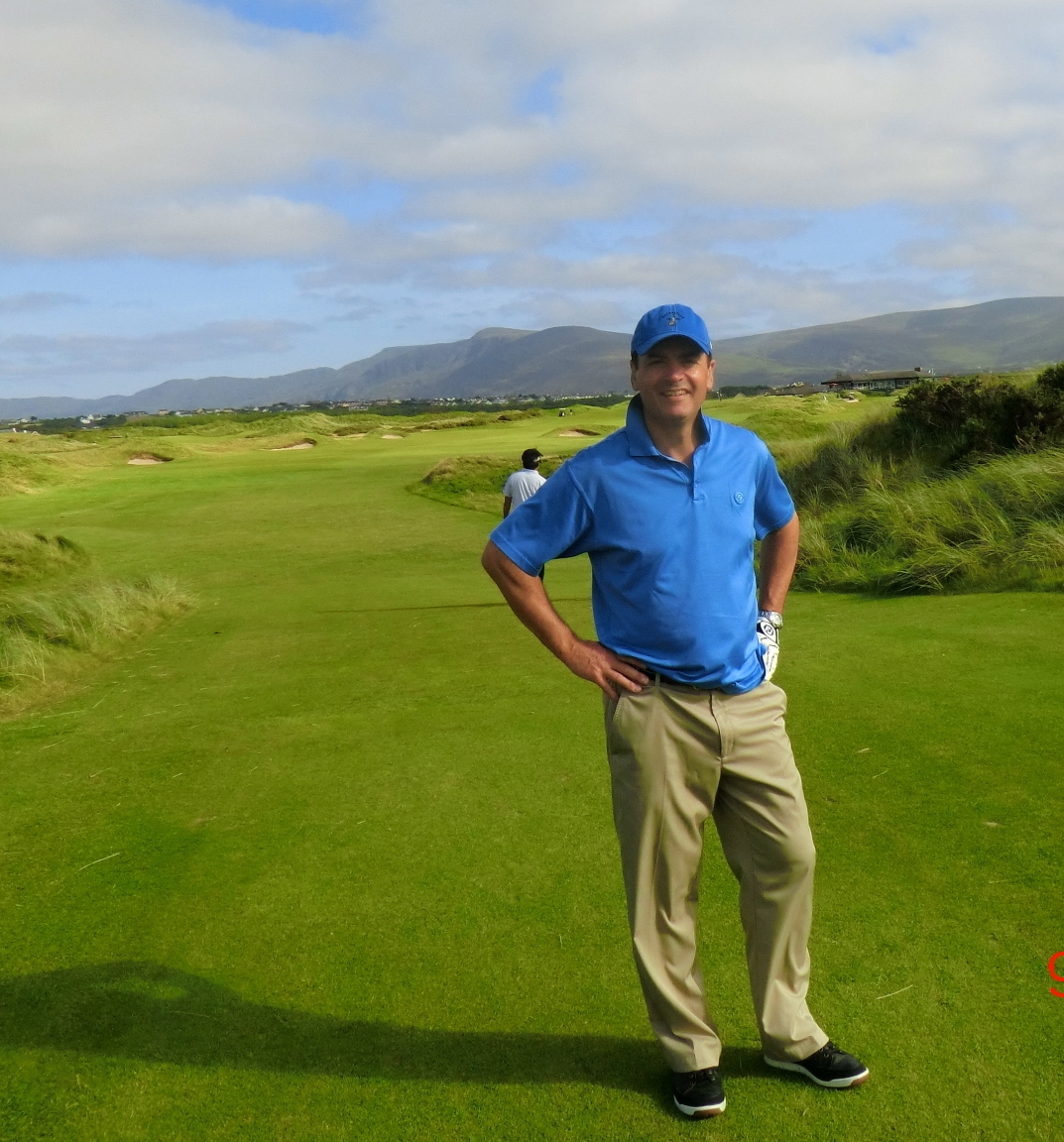
This was our eighth Scottish golf journey, but our first built around Aberdeen. Four Winged Foot friends flew into Edinburgh, collected a van and travelled north for seven days of golf, using the Sandman Signature in central Aberdeen as a single base.
The route was ambitious without becoming a procession of hotel changes. Montrose provided an enjoyable opening stop on the drive north. From Aberdeen we ranged south to Edzell, north to Cruden Bay and Balmedie, and only a short distance to Royal Aberdeen. The decision to remain in one hotel made the week easier: clubs could stay organised, breakfasts became routine and the city offered enough variety for the evenings.
The golf was deliberately repetitive in the best sense. Cruden Bay and Royal Aberdeen were each played twice, allowing first impressions to mature. Cruden Bay became the most distinctive and hospitable overall day; Royal Aberdeen emerged as the finest pure course and the most complete golf experience. Trump International offered the clearest contrast: the original course was a demanding and memorable finale, while the New Course felt over-designed and considerably less rewarding.
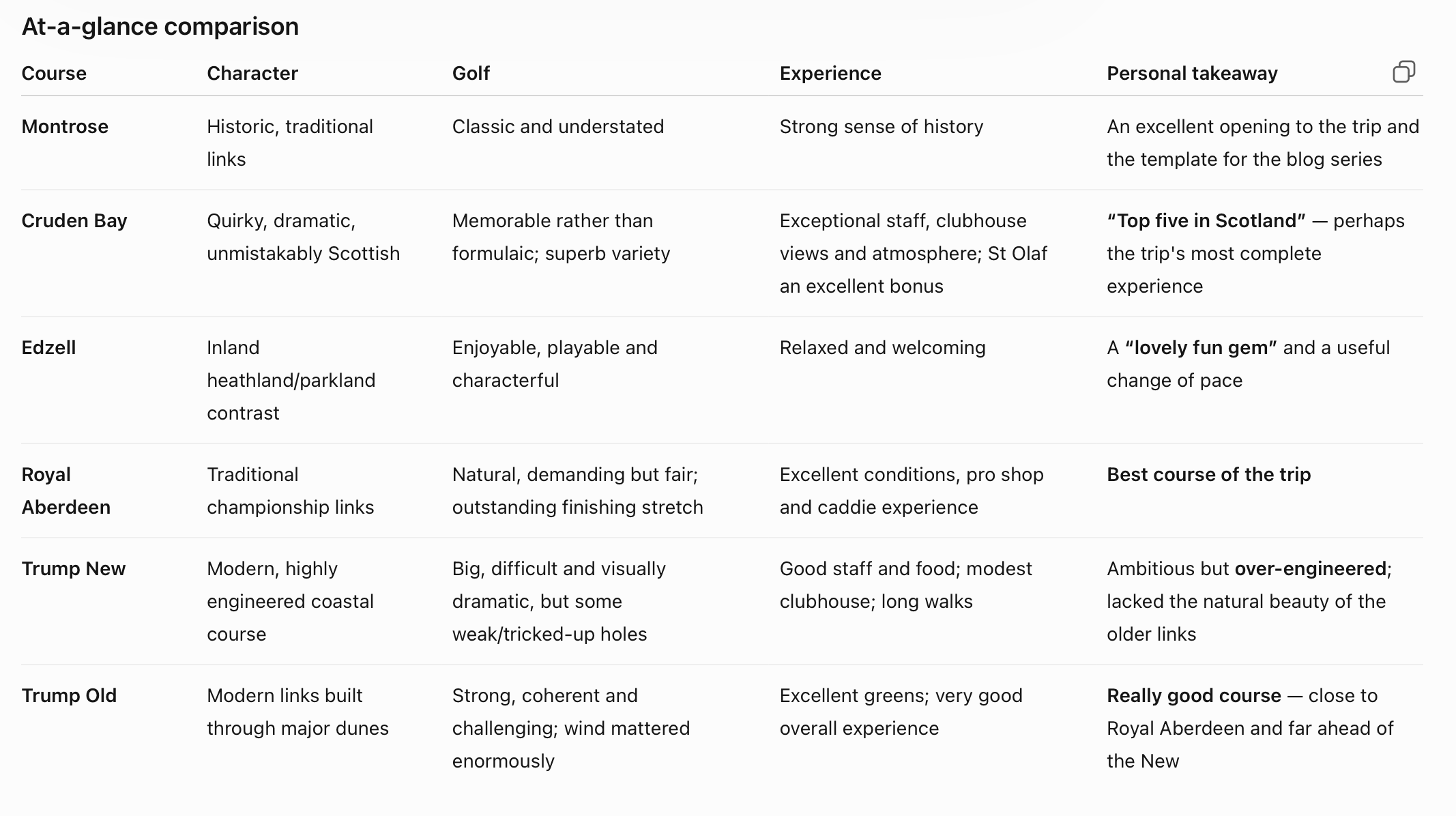
What made the week successful was not simply the quality of the courses. The caddies, professional-shop teams, clubhouse staff and the easy warmth of the smaller clubs mattered enormously. So did the practical pattern: an early breakfast, a manageable drive, time for lunch, and enough room in the schedule to enjoy the club rather than merely play and leave.
The trip confirmed that Aberdeen is not just a staging point for golf. opening round of our Aberdeen Golf Odyssey
An immediate welcome
Montrose Golf Links made a very good first impression. The visitors’ bar and lounge were pleasant, the staff were exceptionally friendly, and the small professional shop across from the first tee was equally welcoming. There was no sense that visitors were being processed through a famous old venue. The club felt relaxed and pleased to have us there.
Kevin acted as our forecaddie. His help was valuable because the correct lines and the behaviour of the ground are not always obvious on a first visit. Local knowledge matters on links courses, particularly when apparently generous landing areas narrow at driving distance or when the better side of a fairway is determined by the angle of the next shot rather than the shortest route to the green.
We were also fortunate with the weather. For most of the afternoon there was bright sunshine, blue sky and very little wind, with the temperature feeling close to 65 degrees Fahrenheit. The wind only became a meaningful factor over the closing four or five holes. For the first round of a Scottish trip, it was about as favourable an introduction as one could reasonably expect.
Why 1562 matters
The course name is based on one of the earliest surviving references to golf in Scotland. James Melville recalled being taught by the Reverend William Gray to use the “glubb for goff” as a boy. Montrose tradition dates that lesson to 1562, supporting the town’s claim to the fifth-oldest recorded golfing ground in the world.
The present course is not a preserved sixteenth-century layout. Golfing ground evolves, and Montrose has been shaped repeatedly. Old Tom Morris was associated with an earlier eighteen-hole course, and Harry Colt finalised the layout of the present 1562 Course in 1913. In 2008 Martin Hawtree realigned the second hole in response to coastal erosion. That combination is part of its appeal: ancient ground, an early twentieth-century routing and a very modern struggle with the sea.
The opening stretch and the sea
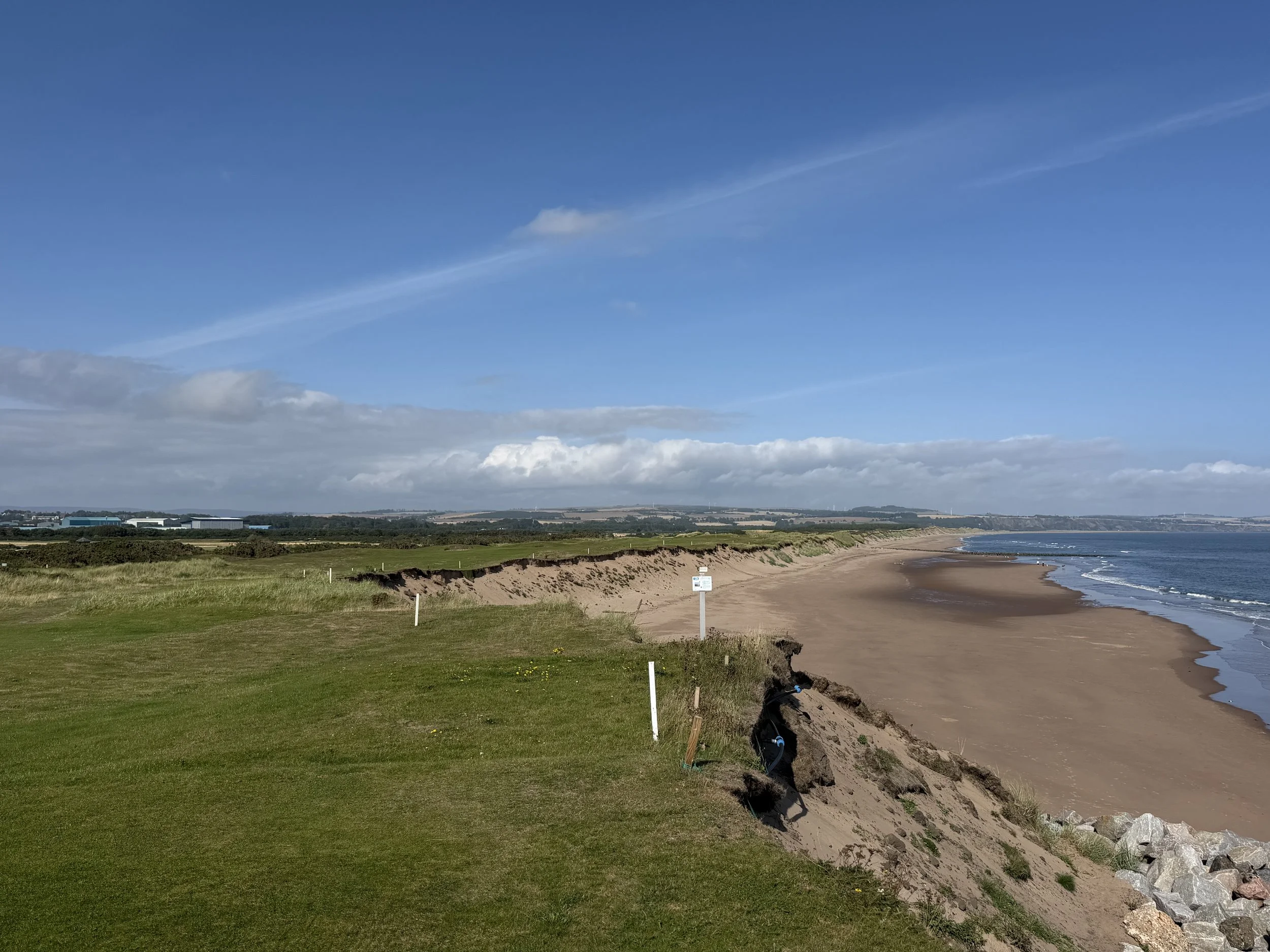
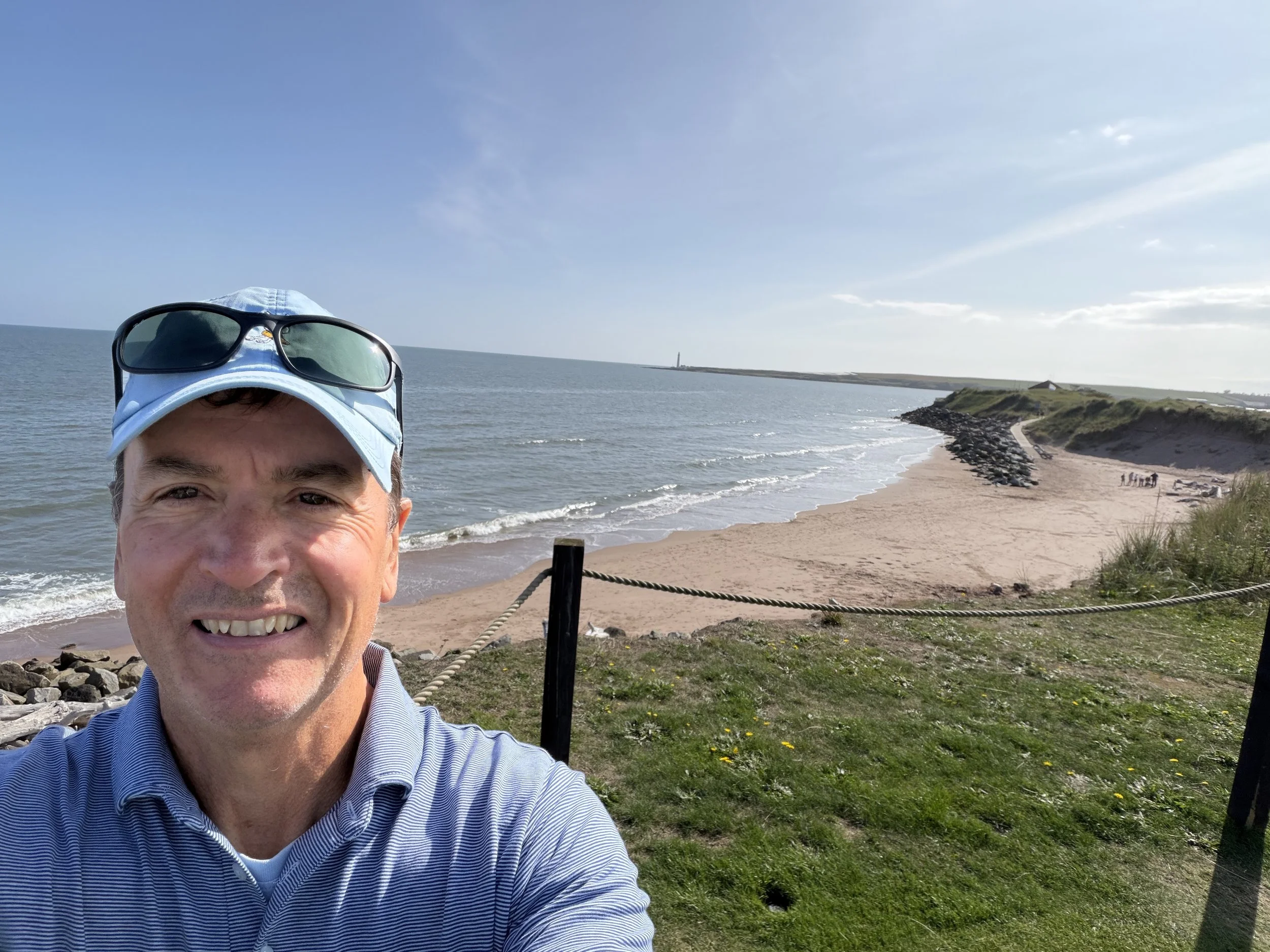
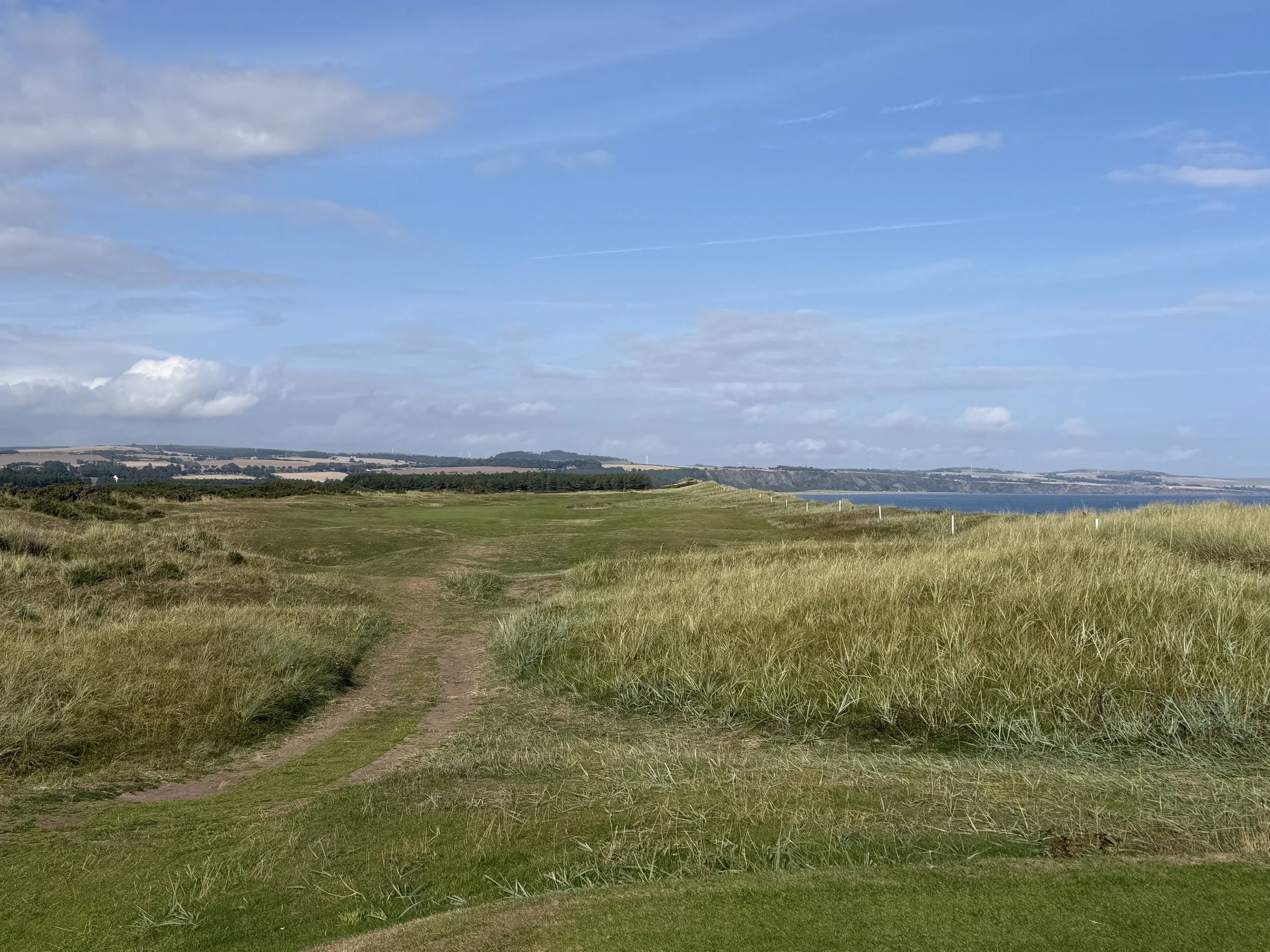
I particularly enjoyed the beginning of the round. The first hole rises towards the coast, and the next several run beside the beach. The views over the water are excellent, with Scurdie Ness lighthouse beyond the southern end of the bay. Yet the most arresting feature is the erosion. The loss of dune and shoreline is visible rather than theoretical, and it gives the early holes a slightly unsettling edge. The sea that creates the setting is also steadily threatening it.
The golf encourages restraint. There is little value in hitting driver towards a small landing area simply because the hole allows it. A hybrid or three-wood that finds the correct position can be much more useful. The same principle applies to approaches. The firm ground invites the running shot, but the bunkers punish poor judgement severely. Playing short and allowing the ball to release often makes more sense than flying it directly to the flag.
That was the clearest lesson from Kevin and from the course itself. Montrose is not overwhelmingly long, but it continually asks where the next shot should be played from. The challenge comes from angles, bunkering, firm turf and the changes in wind, rather than from an attempt to overpower the golfer.
The closing five holes
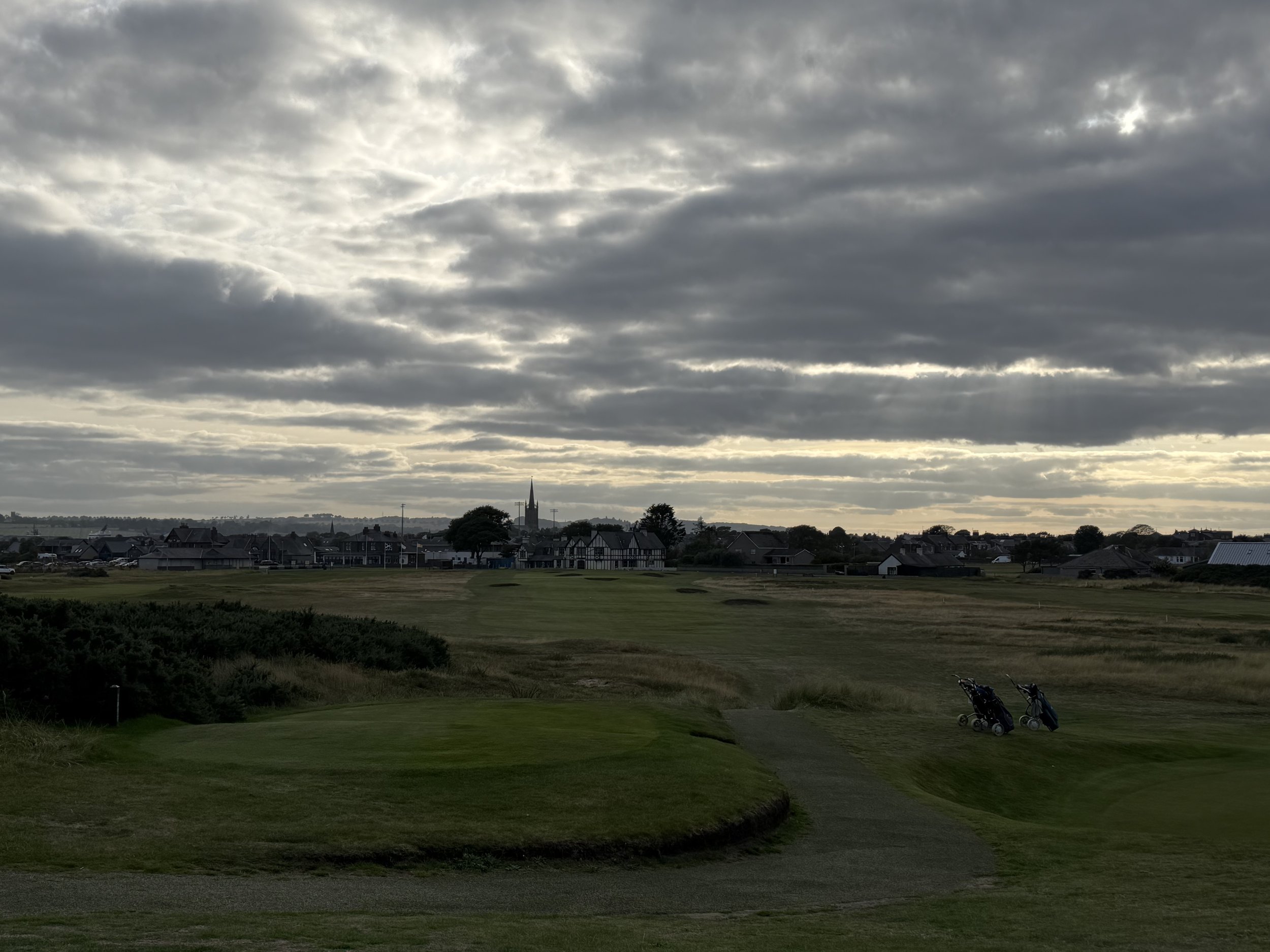
I also liked the final five holes. They feel somewhat broader and more expansive than parts of the outward half, with wider fairways and more room to see the challenge. They are not easy. The bunkering remains important and the green complexes continue to demand a sensible angle of approach. By then the wind had begun to rise, adding the element that had been largely absent earlier in the round.
The town remains present throughout. The great spire of Montrose Old and St Andrew’s Parish Church stands above the skyline and acts almost as a landward lighthouse. Together with Scurdie Ness on the seaward side, it gives the course a particularly strong sense of orientation. You are playing a coastal links, but you never lose the connection with the town immediately behind it.
A course with more to give
My lasting impression was of a very enjoyable course with considerable potential. We were told that further investment was planned. If that proves correct, careful spending on irrigation and infrastructure could make a significant difference. The golf does not need reinvention. Its history, routing and relationship with the coastline are already the essential assets.
Montrose deserves to be more than a name passed on the way to Carnoustie or Aberdeen. It worked extremely well as our opening round: conveniently placed on the drive north, friendly from the moment we arrived and interesting enough to begin the trip with a proper test of links judgement. We teed off at about 1.45 pm, finished close to six and then had an uncomplicated one-hour drive to Aberdeen.
Would I return
Yes. I would readily recommend Montrose to anyone constructing a route between Edinburgh, Carnoustie and Aberdeen. I would return partly for the golf and partly to see how the course responds to the investment and the continuing pressure of coastal erosion. It may not have produced the most dramatic experience of our week, but it was an excellent beginning and a course I was very glad to have played.
An ancient setting, a warm welcome and thoughtful links golf made Montrose an ideal first chapter in the journey north.
Useful links
• Montrose Golf Links Official course website
• 1562 Course Guide Course overview and hole guide
• Visitor Information Green fees, equipment and visitor arrangements
• Book a Tee Time Online visitor booking
• Arnold Clark Edinburgh Airport Airport car and van rental